

Tactile Paving Factory Innovations That Improve Pedestrian Safety
2026-08-14
The humble tactile paving beneath your feet does more than guide—it protects. Yet most pedestrians never notice it until it fails. That’s why factory-level innovations matter more than ever. Beata Ceramics is rethinking how these small, textured tiles are made, turning a safety afterthought into a precision-engineered lifeline. What they’re doing on the factory floor could change how cities prevent accidents.
Beyond Yellow Domes: Rethinking Surface Textures for Real-World Navigation
The familiar grid of raised yellow domes has long served as a tactile stop sign underfoot, guiding countless pedestrians through crosswalks and platform edges. Yet in the messy, ever-shifting terrain of actual cities, these standardized bumps can feel less like a language and more like a one-note alarm. A curb cut obscured by construction, a plaza where the warning strip blends into decorative pavers, or a snowy sidewalk where the domes vanish entirely—each reveals the quiet fragility of relying on a single, uniform texture to carry the weight of safe movement.
Real-world navigation rarely unfolds on a neat, predictable surface. The soles of our shoes and the tips of our canes encounter a rich, chaotic vocabulary: the soft give of rubberized playground flooring, the cool slickness of polished stone, the subtle vibration of metal grates, the gritty resistance of decomposed granite. These are not just background noise; they are usable signals. A shift from coarse to smooth can mark the transition from sidewalk to shared street. A strip of warm, sun-soaked brick can announce an outdoor dining area before any sign comes into view. When we design only for the stark contrast of a yellow dome, we ignore the way people already read the ground as a continuous, nuanced map.
Rethinking surface textures means moving beyond the binary of “warning” and “safe.” It calls for a layered approach where texture, temperature, material, and even sound underfoot work together, offering wayfinding hints that are redundant but not repetitive. A thoughtful designer might pair a subtle directional groove with a change in thermal conductivity, so a person using a cane or bare feet senses the same turn. The goal is not to replace the yellow dome but to surround it with a richer, more forgiving sensory environment—one that acknowledges that real navigation is never just about stopping, but about moving with confidence through a world of constant tactile whispers.
Factory-Level Material Blends That Keep Tactile Paving Slip-Resistant for Decades
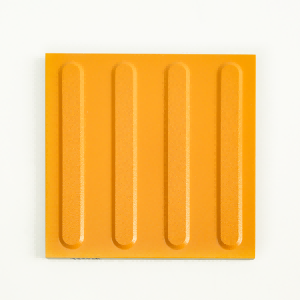
The base chemistry of long-wear tactile paving often leans on a dense polymer concrete that locks aggregate into a near-impermeable matrix. Instead of a thin surface coating that erodes under foot traffic and weather, manufacturers blend vinyl ester or polyester resins with carefully graded silica, basalt, or recycled glass. The result is a slab that holds its profile even after heavy use, because the slip-resistant texture exists through the full thickness of the wear layer rather than sitting on top as a fragile film.
Factory mixing also introduces hard, angular particles such as silicon carbide or calcined bauxite into the wet pour. These grains stay proud of the surrounding binder as it cures, forming a micro-roughness that channels water away from shoe soles and cane tips. Because the particles are distributed evenly under controlled conditions, the paving avoids the patchy grip that comes from manually seeding aggregate on site. In cold climates, the same blend resists freeze-thaw spalling by leaving just enough microscopic void space for ice expansion without cracking the surface.
What makes the slip resistance last for decades is less about a single additive and more about the balance between resin flexibility and filler hardness. Too rigid a binder will micro-crack and let moisture reach the aggregate bond line; too soft a binder will wear smooth within a few years. Leading factories adjust the blend per region, adding UV stabilizers for sun-exposed plazas or hydrophobic fumed silica for constantly wet transit platforms. Each batch is tested for pendulum slip values and Taber abrasion before dispatch, ensuring the paving does not quietly lose its grip after the first winter.
Precision Molding Methods That Eliminate Installation Gaps and Trip Hazards
Getting a seamless fit starts long before the product reaches the job site. Precision molding relies on CNC-machined mold cavities and tightly controlled temperature cycles, allowing each edge and corner to hold tolerances within a few thousandths of an inch. That level of consistency means interlocking sections align without the small offsets or uneven seams that often become tripping points after repeated foot traffic.
The real difference shows up in the details meant to disappear. Recessed fastener pockets, tapered leading edges, and slightly beveled transitions all come from the mold itself, not from secondary trimming. Because these features are formed in one step, there's no hand-filing or shimming needed during installation, which removes the usual sources of gaps between modular pieces and the floor surface around them.
Durability also depends on how the material flows during molding. Using multi-gate injection or compression molding distributes pressure evenly, reducing internal stresses that can cause warping over time. A product that stays flat and dimensionally stable is less likely to lift at the edges, keeping the installed surface smooth and safe without relying on adhesives or heavy anchoring to mask imperfections.
Color-Stable Pigments and UV Barriers That Preserve Contrast in Harsh Sunlight
Bright sun does more than heat up a surface—it slowly dismantles the molecular structure of most colorants. Organic pigments, which offer the widest gamut, are particularly prone to photochemical attack: UV photons cleave double bonds, create free radicals, and turn vibrant reds into chalky pinks. The usual fix has been to load formulations with inorganic pigments like iron oxide or cobalt aluminate. They hold up, but often at the cost of saturation and weight. A better route pairs high-chroma organics with a UV barrier that sits directly on the pigment particle, not just in a clearcoat.
These barriers blend nano-scale titanium dioxide or zinc oxide with surface treatments that prevent photocatalytic damage—otherwise the barrier itself becomes a source of degradation. Hindered amine stabilizers work alongside, mopping up radicals before they reach the chromophore. In accelerated weathering, samples keep a ΔE below 2 after 3,000 hours of xenon-arc exposure, even when facing south at a 45-degree tilt. That kind of retention matters for outdoor wayfinding, EV charging station graphics, and building wraps where contrast is not decorative but functional.
Smart Factory Quality Checks That Catch Inconsistent Stud Heights Before Shipping
On the line, a vision system snaps a dozen images per second, zeroing in on the silhouette of every stud. The software compares each measured height against a tolerance band that tightens with every batch—because even a half-millimeter drift can leave a panel rattling down the road. Operators don't stare at screens waiting for a red flag; the system does that quietly, flagging only the outliers and logging the rest. It's the kind of gate that never blinks, even at 3 a.m.
What makes it stick isn't the camera, but the feedback loop. When a stud starts trending tall, the line nudges the press force before a single bad part leaves the cell. And if a batch does get quarantined, the root cause is already pinned to a station, a spindle, or a worn locator pin. No reinspection marathons, no shipping hold drama. Just data that says exactly where the process drifted and what to adjust next.
In practice, this catches the nasty intermittent stuff—the stud that’s fine on Monday and short on Tuesday because coolant temperature shifted. Traditional spot checks miss those; the inline system doesn't. And because the inspection happens before the crate is sealed, the only parts that hit the dock are the ones that match the CAD model, not the tolerance lottery.
Modular Paving Designs That Adapt to Curbs, Ramps, and Shared Streets
Modular paving shifts the way streets meet their edges. Instead of a continuous concrete pour that must be formed and cured around every curb return or ramp, the system uses precast units with interlocking joints. These blocks can be laid in radial patterns to trace a tight corner, then transition to a straight run without cutting a single piece. On a sloping driveway apron or a wheelchair ramp that changes grade over a short distance, the modules are simply selected from a range of slopes and keyed into place. The result is a surface that reads as one continuous plane but can be lifted and re-laid if the geometry ever needs to change.
Shared streets rely on subtle cues rather than hard separation between cars, bikes, and people on foot. Modular paving makes that possible because you can vary texture, color, and joint width from zone to zone. A band of rough granite setts might run alongside a smooth concrete path, telling a driver without a sign that the space is no longer exclusively for vehicles. Where a curb ramp meets the roadway, the transition can be built from units with a chamfered edge that tucks under the asphalt, so there is no lip to catch a caster wheel. The same system can form curb extensions or bus bulbs, narrowing the crossing distance while leaving the underground utilities untouched.
Over time, the real advantage shows in maintenance and adaptation. A damaged unit is swapped in minutes, not saw-cut and patched. If a street is later converted to a pedestrian-priority zone, the paving can be reconfigured with different modules instead of being demolished. Stormwater can also pass through permeable versions of the blocks, reducing ponding at the base of ramps. Because the joints are designed to shift slightly with freeze-thaw cycles or tree roots, the surface stays flatter longer than a monolithic slab. This kind of paving treats the street as a kit of parts, ready for the next curb realignment or shared-space experiment without starting from scratch.
FAQ
Many plants now use compression-molded glass-fiber reinforced polyurethane instead of cast concrete. This produces a thinner, lighter slab that withstands repeated truck and bus loads without cracking.
They mix high-grade UV-stabilized pigments throughout the entire paver rather than applying a surface coat. Some facilities also add ceramic microbeads that retain brightness even under heavy foot traffic.
Concrete spalls in freeze-thaw cycles and clay is brittle. Recycled polymer blends flex slightly under stress, resist salt and moisture, and can be molded with more precise dome geometry.
Factory-installed beveled edges and recessed installation channels let plow blades glide over the surface instead of catching on dome edges. Some products are also rated for mechanical sweeping equipment.
Controlled temperature, pressure, and curing time mean every dome has the same height, spacing, and slope. That consistency reduces tripping hazards and gives cane users predictable feedback.
Post-consumer plastics are blended with rubber and mineral fillers to create a slip-resistant, non-porous surface. These pavers often outperform virgin polymers because the mixed materials improve impact absorption.
Some factories embed photoluminescent aggregates into the surface surrounding the domes, which store daylight and emit a soft glow for several hours after dark.
They produce large interlocking panels with pre-aligned dome fields. Workers snap sections together without wet mortar, so a crosswalk can be upgraded in one afternoon with fewer open trenches.
Conclusion
The shift away from one-size-fits-all yellow domes has pushed manufacturers to treat tactile paving as a precision safety component rather than a generic street accessory. At the factory level, new polymer and concrete blends lock in slip resistance without relying on surface coatings that wear away after a few seasons. Instead of bolting down pre-formed tiles that leave uneven seams, advanced molding systems now produce panels with interlocking edges and tightly controlled stud geometry, so installers can fit them flush against curbs, ramps, and crosswalks without creating trip hazards. Color stability gets equal attention: pigments are selected for long-term contrast, and UV barrier layers are built directly into the material, keeping the warning surface visible even under relentless sun.
Quality control has also moved from spot checks to automated inspection. Cameras and laser scanners on the production line measure stud height, spacing, and alignment before tiles are boxed, rejecting any batch that would feel inconsistent underfoot or under a cane. Beyond the classic dome profile, factories now experiment with directional bars and blended textures tailored to different navigation tasks—guiding along a shared street, signaling a platform edge, or marking a bus boarding zone. Modular designs make these variations practical: a single system can switch between configurations without weakening the pavement structure. The result is a more responsive, durable tactile surface that adapts to real pedestrian routes instead of forcing every crossing into the same yellow pattern.
Contact Us
Contact Person: Emma
Email: [email protected]
Tel/WhatsApp: 8618064423698
Website: https://www.beataceramics.com/