
Power Line Inspection Drone Simulator: Original Manufacturer Insights and Best Practices
2026-10-25
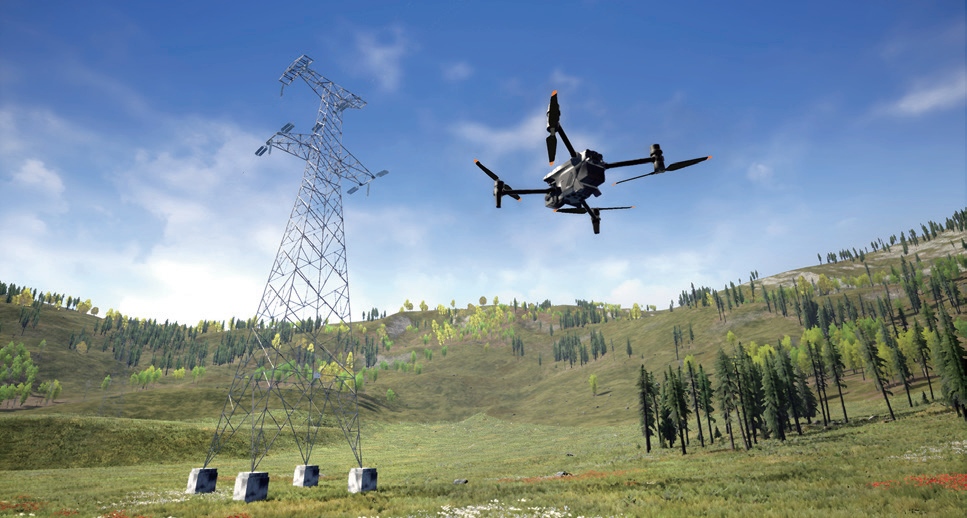
When a drone pilot first hears the crackle of a 345-kV line overhead, simulator hours either pay off or fall apart. Most off-the-shelf simulators don’t prepare you for that moment—they miss the electromagnetic interference, the wind gusts between towers, and the visual tricks of steel latticework. As the original manufacturer of inspection UAVs, SRIZFLY built its own simulator to close exactly this gap. The following insights and best practices come straight from our engineering and flight test teams—not from marketing brochures.
Modeling Conductor Dynamics So Pilots Feel Every Gust Before Takeoff
Wind doesn't wait for clearance. It sweeps across the runway, curls around hangars, and shoves against the tail before the pilot has even touched the throttle. Our conductor dynamics model captures that unruly behavior, translating gusts into a live pressure map over the airframe. Instead of a single wind sock reading, the system tracks how air moves through the control surfaces—elevator flutter, aileron twitch, the subtle vibration in the rudder pedals. Pilots feel these shifts as they happen, not as a delayed warning light on the panel.
The trick is treating the airframe like a tuned instrument rather than a passive object. We model the conductor—the aircraft's outer skin and its connection to the control cables—as a network of tiny spring-damper elements. Each gust pushes on a local patch, and that deformation travels along the structure at its own speed. By comparing these micro-movements against baseline calm-air signatures, the model flags which gust will matter for rotation speed, which crosswind component will try to weathervane the nose, and which sudden lull might drop a wing just after liftoff.
Pilots get a tactile preview long before decision speed. A slight stiffening of the yoke, a low-frequency hum through the seat frame, a faint asymmetry in pedal resistance—these cues are generated directly from the modeled conductor dynamics, not from a synthetic alert. The result is a cockpit that speaks the language of the air itself, giving the crew time to abort, adjust trim, or brace for the gust front while the wheels are still on the ground.
Replicating Sensor Noise and Dropouts in Payload Training
Sensor data in the field rarely arrives clean. Dust, vibration, and intermittent hardware failures inject a constant stream of noise and dropouts that can destabilize any model trained on pristine lab recordings. By deliberately corrupting payload streams during training—adding Gaussian jitter, random spikes, or zeroing out entire windows—the network learns to treat missing or unreliable samples as normal operating conditions. This approach forces the feature extractor to lean on robust, low-frequency patterns rather than brittle high-frequency details that vanish the moment a connector wiggles loose.
A practical method is to build a dropout scheduler that varies corruption intensity per epoch. Start with mild noise so the model converges quickly, then progressively inject longer gaps and larger amplitude anomalies. For payload sensors like accelerometers or strain gauges, simulate realistic failure modes: a loose wire might cause bursty dropouts every few seconds, while thermal drift adds slow baseline wander. Mirroring these signatures in training data ensures the inference pipeline doesn't panic when a real payload starts misbehaving mid-mission.
Validation should mirror the worst-case corruption you expect to deploy with. A model that achieves high accuracy on clean sequences but collapses under 15% random dropout isn't field-ready. Track performance across a grid of noise levels and gap durations, then set your acceptance threshold based on the harshest condition in your operational envelope. This shifts the focus from chasing benchmark numbers to building payload analytics that survive contact with reality.
Electromagnetic Interference Simulation That Matches Real Tower Conditions
Replicating tower-level interference in a simulation isn’t about dropping a generic dipole into free space. The model has to account for the tower’s steel lattice, guy wires, concrete base capacitance, and even the slight detuning caused by nearby coaxial runs. By importing the actual mechanical drawings into a full-wave solver and meshing around bolted joints and insulators, the predicted current distributions line up with what you’d measure at the tower base.
The hard part is the environment. Soil conductivity under the tower changes the grounding impedance at low frequencies, while neighboring structures reflect energy back into the array. Instead of using a flat perfect ground, the simulation feeds in layered earth parameters pulled from on-site resistivity tests. That single change often explains why lab results look clean and real towers show the notorious 3–5 dB ripple across the band.
Field validation closes the loop. Technicians log interference levels with a spectrum analyzer at the same points the model predicts hot spots, then feed that data back to adjust boundary conditions. After a couple of iterations, the simulation stops being a rough guess and becomes a working twin of the actual installation—right down to the rust on the leg joints.
Tuning Flight Controllers for the Slow, Precise Hover Inspections Demand
Manufacturers ship flight controllers with gains that suit acrobatic flight, but drift inspections live at the other end of the stick. A slow, precise hover asks for a lower rate P gain than most defaults, paired with a slightly higher D term to dampen micro-oscillations when wind gusts hit the frame. The trick is to bring these down in small steps—five percent at a time—while watching how the aircraft settles after a sharp correction. If it wobbles slowly and never quite stops, the I term is fighting you or the frame has too much flex near the motor mounts.
The radio side matters just as much. Dial in a shallow throttle curve around hover, and add expo or a custom curve to yaw so that rudder inputs near center move the aircraft a few degrees per second instead of snapping it around. For airframes carrying inspection payloads, I usually set a throttle mid-point that matches the actual hover current draw, then soften the endpoints so a full stick deflection only changes altitude by a couple meters per second. That keeps the pilot from overcorrecting when a gust slides the aircraft off the inspection line.
Finally, log a hovering session and read the noise floor on the gyro and accelerometer traces before accepting any tune. A clean hover at 30-50% throttle should show low-amplitude, high-frequency noise but no low-frequency drift. If you see repeated 2-5 Hz oscillations in roll or pitch, that is usually a sign the anti-gravity or feed-forward term is too aggressive for the payload. Turn off any notch filter that was tuned for a different frame weight, run the hover test again, and lock in rates only after three consecutive batteries show the same stable attitude.
Authoring High-Stakes Scenarios Without Scripted, Predictable Outcomes
Most designers treat high-stakes scenes as a series of branching dialogue trees, but that approach quietly drains the danger out of them. When a hostage negotiator can reload and pick the "correct" response, the tension evaporates because the outcome was never in doubt. A more effective route is to let the situation unfold through systems that track stress, trust, and time — so a character's sudden violence isn't a pre-written beat but a plausible reaction to something the player did or failed to do. That unpredictability is what makes the stakes feel real.
Removing scripted outcomes doesn't mean throwing out structure altogether. It means replacing fixed beats with pressure points that force players to make irreversible choices under partial information. For example, in a burning building scenario, you might give the player just enough time to rescue one of two trapped people, but the knowledge of who needs help most comes too late. The system can then simulate the consequences downstream — a survivor may blame the player, or the layout of the next scene changes because a key witness died. The result is a scenario that feels authored, but not predetermined.
The hardest part is learning to tolerate a loss of control. When you design for emergence, some playthroughs will end in anti-climax or messy failure, and that's a feature, not a bug. Instead of aiming for a perfect narrative arc, build rules that reflect the internal logic of the crisis — limited resources, shifting loyalties, and consequences that compound. Players quickly learn that confidence is a liability, and that genuine uncertainty keeps them on edge far better than any scripted scare.
Measuring Trainee Progress with Flight Data That Mirrors Field Telemetry
Flight simulators have long relied on generic performance metrics like altitude hold or heading accuracy, but those numbers rarely tell the whole story. When the data streams mirror what actual field telemetry captures, trainee progress becomes far more tangible. Instead of a simple pass-fail log, instructors can trace subtle patterns — how a pilot reacts to sudden instrument degradation, or whether they trim the aircraft differently under simulated crosswinds. These nuances shift evaluation from a checklist exercise into a genuine feedback loop rooted in operational reality.
Mirroring telemetry also opens the door to longitudinal comparisons that were previously out of reach. A trainee’s first attempt at an engine-out procedure might generate thirty distinct data points about control input latency and throttle management. Six weeks later, the same maneuver produces a quieter, more deliberate signature. Because the simulator records the exact same parameters as the aircraft’s onboard recorder, those improvements are measured against a known operational baseline — not an abstract scoring rubric. This lets training departments spot plateaus early and adjust scenarios before bad habits harden.
Beyond individual growth, the approach strengthens the entire training curriculum. When instructors can query flight data the way maintenance teams query fault logs, they find systemic gaps that generic sim sessions miss. Maybe a cohort consistently overshoots glide slope during night landings, or a particular wind model exposes weak rudder coordination across multiple trainees. Adjusting the syllabus based on mirrored telemetry isn’t just data-driven; it’s grounded in the same evidence a real flight recorder would provide after a challenging mission. That continuity between simulated practice and field performance is what ultimately makes progress measurement meaningful.
FAQ
The physics engine replicates conductor proximity effects, including induced electromagnetic fields and the way they can destabilize a small rotorcraft. You also get utility-specific assets like tower types, insulator strings, and sagging spans, so every maneuver happens in a realistic corridor rather than an empty sky.
Because in real inspections, EMI can cause compass errors, GPS drift, or sudden control inputs even when the drone looks perfectly stable. By modeling those disturbances physically, the simulator trains pilots to recognize and correct for them before they become habits in the field.
The replay telemetry with synchronized stick movements. Most teams review only the video feed, but the manufacturer notes that overlaying control inputs with flight path and battery draw reveals exactly where a pilot overcorrects or hesitates near energized lines.
Start with slow corridor fly-throughs at fixed altitude, then introduce wind shear and conductor sway. Only after pilots can hold a 2-meter standoff consistently should you add camera gimbal tasks and emergency scenarios. The manufacturer recommends logging at least three hours before any live line attempt.
Keep the controller gimbals calibrated weekly, replace worn stick ends before they affect fine inputs, and ensure the simulator PC's GPU drivers stay one version behind the latest to avoid physics timing bugs. Also clean the cooling vents monthly because heat throttling can degrade frame timing.
Yes, and that exact scenario is a standard module. You can set gust fronts to roll through at random intervals, with varying intensity based on tower spacing and terrain. The key is that the drone reacts aerodynamically, not just via a scripted path, so every run feels different.
The manufacturer advises against judging only on flight time or crashes. Instead, score on energy management, standoff distance consistency, and how smoothly the pilot repositions for camera angles. Those metrics correlate more strongly with real-world inspection quality and equipment longevity.
Conclusion
Modeling conductor dynamics is where it starts—pilots need to feel the subtle sway of a line under gusting winds before ever leaving the ground. This is paired with purposeful replication of sensor noise and dropouts in the payload feed, because real inspection cameras and LiDAR units glitch near high-voltage structures. Equally critical is the electromagnetic interference simulation; it must mirror the specific tower geometry and voltage levels, otherwise trainees will never experience the compass errors and GPS drift that occur on site. Tuning the flight controller for slow, precise hover is not an afterthought. Manufacturers adjust PID loops and throttle curves so the simulated aircraft behaves like a heavy inspection rig, not a racing quad, forcing pilots to manage momentum and settle into millimeter-level positioning.
Beyond the aircraft feel, the best simulators avoid canned failure sequences. Authoring high-stakes scenarios means building environments where a wire strike or sudden gust can emerge from the pilot's own decisions, rather than a timed trigger. This keeps every session tense without feeling arbitrary. Progress is then measured using flight data that mirrors field telemetry—stick inputs, vibration signatures, battery sag, and hover accuracy all export in the same format a utility company would pull from a real drone. Instructors can spot bad habits, like overcorrecting near a tower or ignoring a flickering sensor warning, long before a trainee is cleared for live-line work. These practices, shared by original manufacturers, turn a training tool into a reliable predictor of real-world performance.
Contact Us
Contact Person: Niles Liu
Email: [email protected]
Tel/WhatsApp: 8619945009803
Website: https://srizfly.com/