

Model 207 Dual-Axle Flatbed Trailer: Why a China Manufacturer Leads the Market
2026-06-23
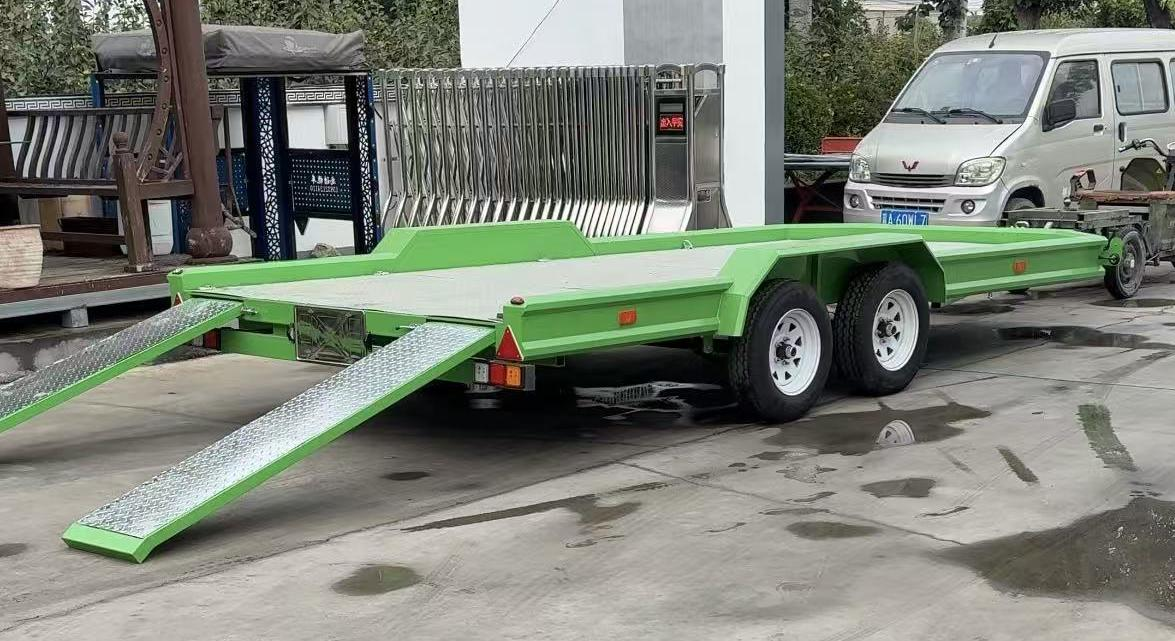
In an industry where downtime directly cuts into profits, the right flatbed trailer isn't just equipment—it's a competitive edge. The Model 207 Dual-Axle Flatbed Trailer has quietly become the go-to choice for fleets demanding durability without the premium price tag, and a closer look reveals why one Chinese manufacturer is pulling ahead of the pack. Whole Chain Tech has turned engineering precision and supply chain mastery into a trailer that outperforms expectations, reshaping what buyers should demand from their next fleet upgrade.
Why the Dual-Axle Design Actually Makes a Difference on Rough Terrain
Most standard trailers rely on a single axle, which works fine on smooth pavement but quickly becomes a liability once you hit uneven ground. The problem is weight distribution: with just one pivot point, every bump or dip transfers motion directly into the trailer, making it bounce, sway, or even lose contact with the ground. Each wheel has to absorb the full force of the terrain in sequence, which amplifies vibration and stress on the frame. Over time, this pounding can loosen fasteners, fatigue metal components, and jostle cargo loose—especially fragile items.
A dual-axle setup changes the physics entirely. By adding a second axle and a load-equalizing suspension, the trailer effectively gains a walking beam action. As one wheel rises over an obstacle, the opposite wheel presses down, maintaining ground contact and spreading the impact across multiple points. This balances the load dynamically, reducing the peak force sent through the chassis. Off-road, where rocks, ruts, and washboard surfaces are the norm, this translates to dramatically smoother tracking and less side-to-side rocking. You’ll feel the difference in the driver’s seat—less bucking, quieter towing, and far more control on descents.
Durability is another hidden advantage. Dual axles share the burden of carrying the trailer’s weight, so tires and bearings run cooler and last longer under heavy loads. If a tire blows on a single-axle trailer, you’re stranded instantly; with a dual-axle, the remaining three can often support the rig long enough to reach safer ground. For serious off-grid adventurers, this redundancy is a game-changer. It’s not just about getting through rough patches—it’s about knowing your setup won’t fail you when you’re miles from civilization, with your gear still intact and your peace of mind untouched.
Inside the Factory: Steel That Outlasts Standard Specs
Walking through the production floor, the heat from the electric arc furnace hits you long before you see the glow. Here, scrap metal is transformed into a molten pool that's carefully tweaked with precise alloys—a dash of vanadium, a measure of chromium. It's not just about meeting a spec sheet; the team pushes the chemistry until the steel's grain structure tightens in ways that standard grades can't match. Each batch is sampled and etched under microscopes, the resulting micrographs pinned to a board like proud artworks, showing a uniform matrix that promises survival in the harshest conditions.
The real magic happens at the quenching bath, where plates hiss and steam billows in calculated timing. Standard practice might cool steel quickly and call it done, but these folks have mapped out a proprietary thermal curve that dips and holds, teasing out hardness without brittleness. A veteran metallurgist once joked that they're baking a cake, not just hardening metal. The result is a beam or panel that laughs at salt spray tests, slowly oxidizing over decades rather than years.
Away from the sparks, the testing rigs tell the final story. Beside a stack of conventional samples—pitted and warped from accelerated corrosion cycles—their steel sits almost smug, bearing only a patina. Engineers here don't talk much about longevity; they just point to a bridge girder fabricated from this stuff that's been holding up for thirty years with barely any maintenance. It's the quiet confidence of a product that was never meant to just pass a checkmark but to quietly outperform.
Safety Features You’d Expect on a Premium Trailer, at a Fraction of the Price
When you’re hauling precious cargo, peace of mind comes from knowing your trailer is built with safety at its core. We’ve integrated reinforced steel crossmembers and a fully welded frame that shrugs off road fatigue, so you never have to second-guess structural integrity. The independent suspension system doesn’t just smooth out bumps—it keeps your load stable in crosswinds and sudden maneuvers, dramatically reducing sway compared to cheaper leaf-spring setups.
Lighting is where many trailers cut corners, but ours includes fully sealed, shock-resistant LED lights that stay bright through rain, mud, and years of vibration. The wiring harness is marine-grade, routed through protective conduit to eliminate chafing. Large, strategically placed reflectors and a high-mounted third brake light increase visibility day or night, giving trailing drivers a clear signal long before they’re on your bumper.
Braking is another non-negotiable. Our dual-axle models feature electric brakes on both axles with a breakaway system that automatically stops the trailer if it ever separates from your vehicle. The coupler locks onto the hitch ball with a positive clamping mechanism, backed by safety chains that exceed minimum requirements. It all adds up to a level of protection that rivals trailers twice the price — because we believe safety isn’t a luxury, but a baseline.
Building a Flatbed That Matches Your Exact Cargo Needs
Every load tells a story, and a standard flatbed rarely has the right chapters. Maybe you're hauling precast concrete panels that demand a perfectly level deck with zero flex, or you're moving agricultural equipment with awkward protrusions that snag on fixed rub rails. Rather than forcing your cargo to adapt to the trailer, start by mapping out exactly how weight distributes across the axles during a typical run. Map the contact points, overhangs, and any need for recessed tie-down pockets that sit flush when not in use. This isn't about adding features for the sake of it—it's about eliminating every point of friction between your load and the road.
The deck itself is where most customization hides in plain sight. For steel coils or heavy machinery, you might integrate a reinforced center channel that bears the brunt of the weight, while keeping the outer sections lighter to maximize payload capacity. Flooring isn't just wood versus aluminum either; consider composite materials with embedded grit for traction, or slotted systems that let you position chocks exactly where needed without drilling fresh holes each season. Even the beavertail and ramp angles benefit from a rethink: a shallow taper might work for low-clearance equipment, but a steeper, reinforced lip could be the difference between a smooth loading sequence and a bent edge on day three.
Don't overlook the long-term play. A trailer designed with modular components—removable sides, adjustable bolsters, or interchangeable extension pieces—gives you flexibility without committing to a complete rebuild later. Think about how your cargo mix shifts over the year. A harvest season for farm equipment might give way to structural steel deliveries come winter. Building a flatbed that grows with your business means looking at the welds, the wire routing for lighting, and even the underbody storage for straps and chains as evolving tools rather than fixed specs. When the trailer fits your workflow naturally, you stop worrying about the equipment and start focusing on getting the job done right.
Hear from Operators: What They Say After 100,000 Miles
The first thing that always comes up when you ask about the 100,000-mile mark is how the little things start to matter. One operator told me he never thought much about the seat cushioning until he’d spent that many hours behind the wheel. “You realize the machine’s been holding up, but your back needs a little more love,” he laughed. It’s those subtle signs of wear—both on the equipment and the operator—that define the long-haul experience. The rig might still pull strong, but now you know exactly where the cab rattles and which gauge reads a hair optimistic.
Another longtime operator put it simply: trust. After 100,000 miles, you’ve seen every weather pattern, every load imbalance, every late-night fuel stop. You and the truck have built a kind of silent understanding. “She tells me when something’s off before the warning lights do,” he explained. It’s not some mystical bond—it’s just familiarity. The engine’s hum, the shift timing, even the way the trailer tracks on a crowned road—after enough trips, they become second nature. That’s when you know you’re not just driving a piece of equipment; you’re piloting something you’ve earned the right to call your own.
Then there’s the perspective you gain on the industry. A younger operator might focus on horsepower or tech features, but past 100k, the conversation always turns to durability and dealer support. “I stopped caring about the fancy dash screen when I realized how often it glitched in the cold,” one veteran shrugged. What sticks with you is which components never failed and which mechanic actually listened when you described a noise. The miles have a way of stripping away the brochure talk and leaving you with a clear-eyed view of what really works on the road.
How China’s Manufacturing Scale Translates to Faster Delivery and Fewer Delays
When a manufacturing base reaches a certain size, it naturally shortens the time between order and shipment. China’s factories aren’t just large—they’re often surrounded by clusters of specialized suppliers that can jump into action without weeks of lead time. Need a custom mold, a specific electronic component, or a last-minute packaging tweak? The sheer density of industrial parks means you’re rarely waiting on a single bottleneck. Production lines can be reconfigured and scaled almost overnight, turning what might be a month-long delay elsewhere into a matter of days.
It’s not just about having many workers; it’s about the depth of the supply chain. In many sectors, from textiles to consumer electronics, every layer of production happens within a tight geographic radius. This vertical integration means a factory doesn’t have to pause because a sub-supplier overseas is running late. Materials move from one facility to the next with a rhythm that feels almost predictive. And when demand spikes unexpectedly, the ecosystem can absorb the shock because there’s always some idle capacity a stone’s throw away.
Beyond the factory floor, the logistics infrastructure has been built to match this output. Ports operate with astonishing throughput, and freight forwarders are accustomed to handling last-minute bookings without chaos. Customs procedures, while still rigorous, benefit from decades of refinement for high-volume trade. The result is that a batch of products can go from final assembly to a container ship with fewer surprises. For buyers, that consistency means planning becomes more reliable; the dreaded “it’s stuck at the port” message becomes far less common.
FAQ
Chinese manufacturers have developed a robust supply chain for raw materials like high-strength steel, coupled with large-scale production facilities. This integration keeps material costs down while maintaining consistent quality. For the Model 207, specialized welding techniques and automated assembly lines ensure each unit meets international standards without the premium pricing often seen elsewhere.
The Model 207 typically offers a more favorable strength-to-weight ratio. Engineers optimize the frame design using computer modeling to reduce weight without sacrificing load capacity. You'll find features like reinforced cross members and adjustable tie-down points that often come as expensive add-ons from non-Chinese brands. The corrosion-resistant coating also gets frequent updates based on real-world feedback from global clients.
Proximity to steel mills and component fabricators shortens lead times dramatically. Instead of ordering parts from multiple continents, a single industrial park can supply axles, jacks, lighting, and suspension systems. This setup allows for rapid prototyping—if a buyer requests a specific deck length or hitch type, the engineering team can reconfigure the production line in days rather than weeks.
Absolutely. The dual-axle design distributes weight effectively, and the frame undergoes stress testing that simulates years of road vibration. Many units operating in Australian mining sites and North American interstates have logged tens of thousands of miles without structural failure. Regular third-party inspections, often by agencies like SGS or Bureau Veritas, add an extra layer of quality assurance for export orders.
Beyond the initial purchase price, the long-term value is compelling. Spare parts are readily available and cost a fraction of what European or American equivalents charge. Direct communication with factory engineers means problems get solved without navigating layers of middlemen. This hands-on support, paired with flexible payment terms, creates a partnership rather than a one-off transaction.
Almost every dimension can be tailored—deck height, overall length, axle spacing, and ramp styles. Buyers often request specific paint colors, anti-slip surfaces, or integrated toolboxes. For specialized cargo like lumber or agricultural equipment, reinforced side rails and additional D-rings are common mods. The factory keeps a library of past customizations, so unique requests rarely start from scratch.
Reputable manufacturers assign a dedicated project coordinator who remains the point of contact long after delivery. Video calls and instant messaging bridge the time zone gap, allowing real-time troubleshooting. Common wear parts are stocked in overseas warehouses, and if major repairs are needed, the manufacturer can dispatch technicians to on-site locations. This level of service has been a game-changer for fleet operators.
Conclusion
When you put the Model 207 through its paces on rough terrain, the dual-axle design quickly proves it isn't just a spec sheet detail. It spreads weight more evenly, reducing bounce and sway on rutted job sites, which operators say keeps the load stable and cuts down on the kind of fatigue that wears out both driver and equipment. Underneath that composure is steel from a factory process that goes beyond standard grades—thicker, better-treated beams that resist rust and warp long after cheaper trailers start showing their age. The result is a flatbed that handles the abuse of construction and agricultural hauling without the constant need for reinforcement, a point that comes up again and again in feedback from drivers who have clocked over 100,000 miles.
That durability doesn’t force you to compromise on cost or features. The Model 207 packs in safety elements—think reinforced rub rails, integrated tie-down points, and a braking system tuned for heavy loads—that you’d normally associate with a premium price tag, yet it comes in significantly under what competitors charge. Part of that comes from the manufacturer’s ability to custom-build at scale: whether you need a specific deck length, side kit mounts, or a particular weight distribution, the production line adapts without the usual delays. Leveraging China’s concentrated supply chains, the factory turns orders around faster and navigates logistics bottlenecks more smoothly, so delivery timelines are not just promises but reliable commitments. For fleet owners, that combination of tailored design, field-tested toughness, and simplified procurement explains why this dual-axle flatbed keeps gaining ground.
Contact Us
Contact Person: Ethan
Email: [email protected]
Tel/WhatsApp: +86 13963964935
Website: https://www.wholechaintech.com/