

KYN28-12 Medium Voltage Switchgear IEC Standard Compliance Essentials
2026-11-02
When a KYN28-12 panel fails an IEC audit, it’s rarely because someone ignored the standard—it’s usually because they stopped at the nameplate. That gap between nominal compliance and field-level reliability is exactly where switchgear problems start. This guide digs into the compliance essentials most manufacturers mention but few actually explain: dielectric performance, internal arc classification, and mechanical interlocking. And if you want to see how those requirements translate into real-world design decisions, MOLDVOLT offers a closer look at the engineering choices behind every cabinet.
What IEC 62271-200 Internal Arc Testing Looks Like inside a KYN28-12 Panel
Once the test begins, a thin copper wire is placed across the busbars or cable connections to trigger a dead short. The arc ignites almost instantly, reaching temperatures over 10,000°C inside the KYN28-12 compartment. Within milliseconds, the surrounding air expands violently, pushing pressure against the panel's walls and door. You'll see the door bulge slightly before the pressure relief flaps on top of the switchgear pop open, releasing superheated gases and plasma upward. Cotton indicators placed around the enclosure start to smolder or catch fire only if hot particles escape through any unintended gaps.
Inside the panel, copper and steel vaporize into a dense cloud of metal fumes, coating internal surfaces with a black residue. The arc churns across the busbar chamber, melting insulating sleeves and scorching paint. Engineers watch high-speed cameras and pressure sensors to confirm the arc energy stays within the classification limits, typically 25 kA or 31.5 kA for 1 second. A successful test means all doors remain closed, the relief system works as designed, and no dangerous gases leak toward the operator zone at the front of the panel.
Voltage Withstand Checks That Catch Insulation Flaws before 12kV Switchgear Ships
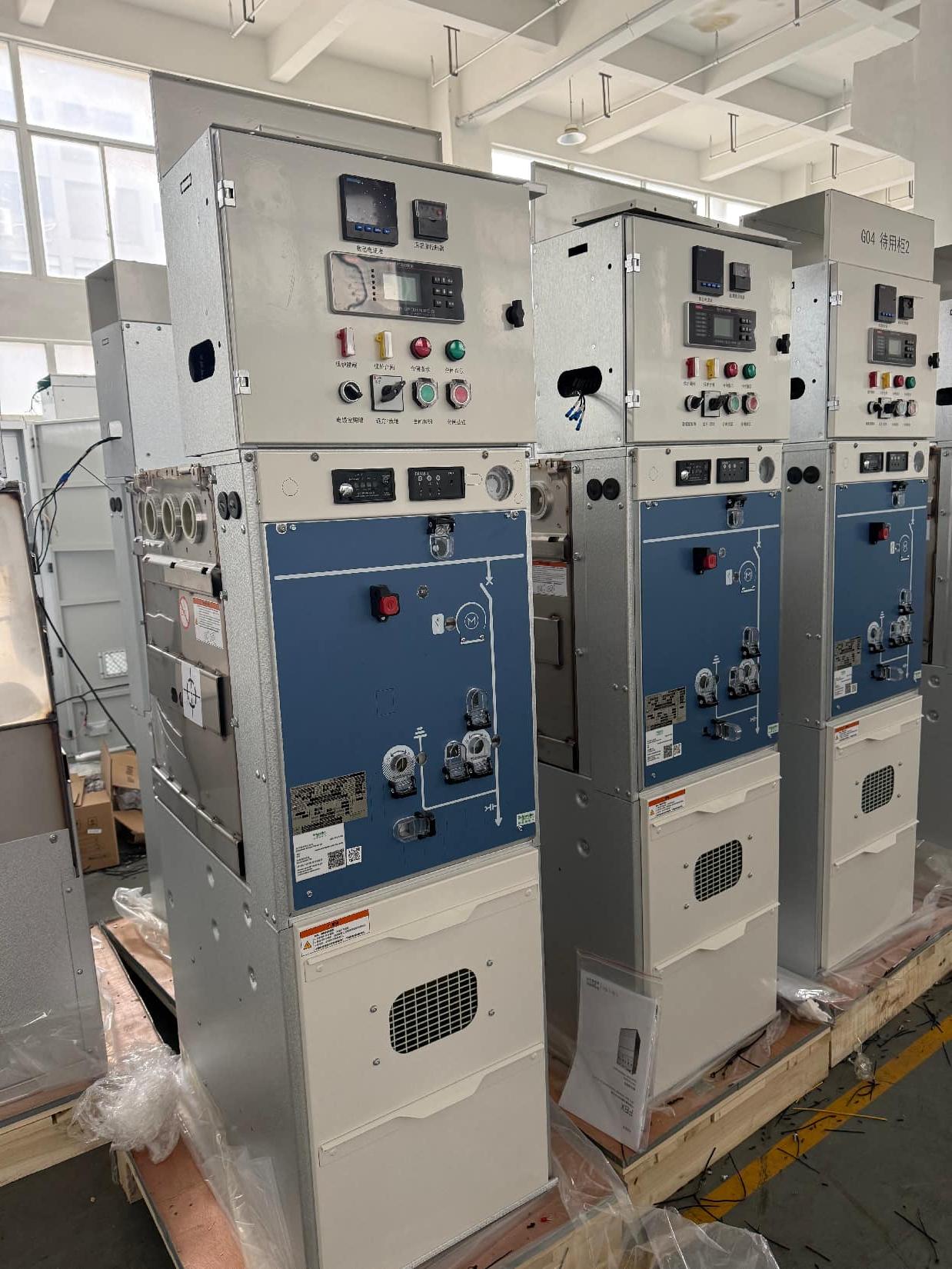
Routine voltage withstand testing on a 12kV switchgear line-up does more than verify dielectric margins. It forces dormant assembly errors into the open: a busbar support that was over-torqued and micro-cracked during erection, a control wire pinched behind a side sheet, or an epoxy void in a voltage transformer that passes a low-voltage megger check. Running each phase against ground and between phases at well above nominal stress for a full minute gives those flaws enough time to grow into a measurable leakage path instead of hiding until energization.
The real value lies in how the test data is read. A simple pass/fail light misses borderline insulation that weeps current near the end of the hold or a slow upward drift in microamps after the first ten seconds. Skilled test technicians watch for corona hiss, erratic leakage current, and partial discharge spikes on the display. When a questionable trace appears, they don't just re-test and hope for a better number; they isolate the affected compartment, clean or re-dress the suspect insulation, and run the check again. That loop inside the factory is cheap compared with finding the same weakness during a customer's five-minute acceptance test.
Catches made here also prevent shipping damage from turning a minor defect into a major failure. A switchgear section that leaves the plant with a tiny nick in a cable lug's heat-shrink may survive the vibration test but fail after it's bolted into a humid substation. Voltage withstand checks act as the last controlled electrical stress before the equipment is wrapped, lifted, and trucked to a site where rework means crane delays and schedule penalties. That's why the final hipot isn't treated as a formality—it's the last chance to catch a flaw before it boards the truck.
Earthing Switch Interlock Logic Required by IEC 62271-102 for Safe Cable Access
The interlocking requirements in IEC 62271-102 exist for a practical reason: nobody should open a cable compartment while the cable can still hold a charge or be energized from the other end. The earthing switch is the final step in a sequence that removes that risk, so its interlock logic forces you to prove the circuit is isolated before you can earth it. You cannot close the earthing switch unless the associated disconnector or circuit breaker is already open. That simple rule prevents a direct fault from closing an earth switch onto a live bus or cable, which would be both dangerous and damaging.
Once the earthing switch is closed, the interlock turns its attention to the access point. The cable compartment door or cover stays locked until the earthing switch gives a positive closed indication. That indication must come from the switch position itself, not just from an auxiliary relay that could be bypassed. In many designs, a mechanical key is released only when the earthing switch is fully closed and the disconnector is open. That key then transfers to the cable compartment lock, allowing the panel to be opened. If someone tries to open the door out of sequence, the interlock simply will not release the key.
The same logic protects the reverse operation. You cannot close the disconnector or circuit breaker while the earthing switch is still closed, because the interlock chain prevents the key from returning to the disconnector until the cable compartment door is closed and locked again. This creates a closed loop: isolate, earth, access, restore, de-earth, re-energize. IEC 62271-102 does not dictate every mechanical detail, but it requires the interlock arrangement to be robust enough that a single missed step cannot expose personnel to live parts. For cable access, the earthing switch interlock is never an optional extra; it is the difference between a controlled procedure and a serious hazard.
How Busbar Temperature Rise Limits in IEC 62271-200 Shape KYN28-12 Ventilation
IEC 62271-200 does not treat busbar temperature rise as a separate material property. It binds the allowable conductor temperature to the weakest adjacent elements, such as bolted joints, insulating supports, and cable terminations, because those parts fail long before the copper bar itself becomes a problem. In a KYN28-12 cabinet, the busbar chamber sits close to the top of the panel, where hot air collects, so the practical limit is often reached there first rather than at the main horizontal run.
The ventilation path through the KYN28-12 enclosure directly controls how quickly that heat leaves. These panels typically use low-level inlets and high-level outlets to create a chimney draft. If the vents are restricted, if internal partitions block the upward flow, or if gaskets are fitted too tightly around the busbar compartment, the draft weakens and the busbar temperature rise climbs even at rated current. IEC 62271-200 type tests therefore evaluate the complete assembly, including all fitted vents and covers, under the declared current and a 40°C ambient reference.
Designers balance this by adjusting vent area, inlet position, and busbar spacing so the hottest bolted joint remains within the allowable rise without sacrificing the panel's IP rating or arc containment. A fully open vent scheme may cool well, but it gives internal arc gases an easier escape path, which KYN28-12 designs usually avoid by using narrow louvres, baffles, or pressure-relief flaps that open only under fault pressure. The result is a ventilation layout tuned to the standard's temperature-rise test, not to maximum airflow alone.
IP Ratings and Corrosion Protection for KYN28-12 Enclosures beyond the Datasheet
A datasheet listing IP4X or IP5X for a KYN28-12 enclosure rarely tells the full story once the switchgear is installed in a coastal substation or a chemical plant basement. The standard tests use controlled dust and water spray, but they don't simulate months of salt-laden humidity seeping through cable glands, condensation forming on internal partitions, or corrosive gases attacking the edges of ventilation louvres. In practice, the weakest points are almost never the flat panel surfaces; they are the gasketed door seams, the bolted busbar compartment covers, and the places where powder coating has been scratched during assembly or transport.
Corrosion protection for these enclosures goes well beyond a final coat thickness. The steel substrate, often galvanized or made from alu-zinc alloy sheet, can lose its protective layer at every cut edge, weld bead, and drilled hole. A robust process includes chemical pretreatment, a zinc-rich primer, and a UV-resistant topcoat applied after all machining is complete, not before. Fasteners and hinges should be stainless steel or have a comparable corrosion class, otherwise they become the first rust spots and compromise the seal integrity. Small design choices, like using closed-cell EPDM gaskets instead of open-cell foam, make a far bigger difference in humid or saline environments than a higher IP number on paper.
Beyond the datasheet, verification matters more than marketing language. Some operators now require salt spray testing on complete enclosure corners, not just flat coupons, and condensation tests with thermal cycling to check for water accumulation near the cable compartment floor. The pressure relief flap must still open under an internal arc while keeping rain and dust out during normal operation, which demands careful attention to seal geometry and gasket compression set. Regular field inspections of KYN28-12 enclosures in corrosive areas often reveal that corrosion starts at the bottom plate and around the door interlock mechanism, so those zones deserve thicker coating or additional sealing even when the rated IP class suggests sufficient protection.
Mechanical Endurance Expectations for Vacuum Circuit Breakers under IEC 62271-100
IEC 62271-100 sets clear mechanical endurance benchmarks for high-voltage circuit breakers, and vacuum interrupters consistently outperform many alternatives in this area. The standard distinguishes between two classes: M1, which demands 2,000 mechanical operating cycles, and M2, which extends that requirement to 10,000 cycles. Because vacuum breakers have a small number of moving parts and no arc-quenching medium to replenish, they naturally lend themselves to meeting the more stringent M2 rating without excessive wear on the operating mechanism.
The mechanical endurance test under this standard is conducted without voltage or current load, focusing purely on the integrity of the drive train, latching systems, and contact movement. Test sequences typically involve a prescribed mix of open and close operations at rated auxiliary voltage, with checks for contact travel, speed, and synchronization after a set number of cycles. For vacuum circuit breakers, the key concern is usually not contact erosion (since arcing is absent in the mechanical test) but rather fatigue in springs, linkages, and bearings — components that can degrade silently if not properly designed or lubricated.
In field practice, many vacuum circuit breakers exceed the M2 expectation, often reaching 30,000 or more mechanical operations before any significant maintenance is needed. However, the IEC rating should not be mistaken for a guaranteed service life; environmental factors like dust, humidity, and temperature swings can accelerate wear on external operating parts. Routine inspections of the mechanism, periodic lubrication, and occasional contact wipe measurements help ensure that the breaker continues to meet its mechanical endurance promise long after the factory test report has been filed away.
FAQ
KYN28-12 is a metal-clad, withdrawable indoor switchgear rated at 12 kV. The 'K' indicates metal-clad, 'Y' means withdrawable, 'N' stands for indoor, '28' is the design series, and '12' is the rated voltage in kilovolts. It is typically equipped with vacuum circuit breakers and is common in utility substations, industrial plants, and infrastructure projects where a compact footprint and high reliability are needed.
IEC 62271-200 is the main standard for AC metal-enclosed switchgear and controlgear for rated voltages above 1 kV and up to and including 52 kV. For KYN28-12, this standard sets requirements for design, construction, type tests, routine tests, and safety features like partition classes, accessibility, and internal arc classification. The circuit breaker inside typically follows IEC 62271-100, while instrument transformers and disconnectors have their own related IEC standards.
The switchgear is normally designed with a reinforced compartment structure, pressure relief channels, and dedicated vent flaps on top to safely redirect hot gases and overpressure away from the operator. The internal arc classification, such as IAC AFLR 31.5 kA 1 s, means the cubicle is tested to withstand an internal arc on all accessible sides for a specific current and duration. This prevents injury to personnel and limits damage to the installation during a fault.
The essential type tests include dielectric tests at power frequency and lightning impulse voltage, temperature rise tests to verify current-carrying capacity, short-time and peak withstand current tests, making and breaking tests for the circuit breaker, mechanical endurance tests for the withdrawable parts, and internal arc tests. These are normally conducted at accredited laboratories on representative units, and the reports form the basis for claiming IEC compliance.
Under IEC 62271-200, the switchgear can be built with different partition classes and loss of service continuity categories. KYN28-12 commonly uses a metal-clad construction with separate compartments for the busbar, circuit breaker, cable, and low-voltage equipment. Metal shutters automatically close over the live contacts when the breaker is withdrawn to the test or disconnected position, preventing accidental contact with live parts.
Routine tests required by IEC include a power-frequency voltage withstand test on the main circuit, verification of auxiliary circuits and wiring, mechanical operation tests of the circuit breaker and withdrawable components, and checks of interlocks, clearances, and earthing continuity. For panels with internal arc classification, a visual check and pressure relief verification may be done, but the full internal arc test is a type test, not routine.
Yes, the switchgear can be adapted to different earthing methods. The voltage rating, insulation level, and protection settings must match the system earthing arrangement. For an isolated or resonant-earthed system, the switchgear may need a higher rated insulation level and specific relay coordination to handle longer fault clearing times. The manufacturer normally confirms the exact configuration with the customer based on the network's neutral treatment.
The documentation package typically includes type test certificates or reports from an independent laboratory, routine test reports for each panel, a declaration of conformity, single-line diagrams, layout drawings, and instruction manuals covering installation, operation, and maintenance. For safety-critical installations, an internal arc test certificate and a list of approved spare parts and accessories are also supplied.
Conclusion
When a KYN28-12 panel is put through IEC 62271-200 internal arc testing, the focus isn't just on surviving the blast—it's about controlling where the pressure and hot gases go. The test rig measures everything from indicator cloth ignition to door deformation, and a passing design means the arc fault energy gets safely vented through the top or rear, not into the operator's face. But compliance doesn't stop there: voltage withstand checks, typically power-frequency and lightning impulse, are applied to every critical insulation path before shipping. These tests catch hairline cracks in bushings, insufficient creepage distances, or contaminated surfaces that a simple visual inspection would miss. Then there's the earthing switch interlock logic mandated by IEC 62271-102—this is what prevents someone from opening the cable compartment while the busbar is still live. The mechanical sequence has to be foolproof: breaker off, then earthing switch closed, then door unlocked. No shortcuts, because cable access is where fatalities happen.
On the thermal side, IEC 62271-200 sets busbar temperature rise limits that directly dictate ventilation sizing in KYN28-12 enclosures. You can't just slap on a bigger fan; the airflow pattern has to keep hot spots under the limit, typically 65 K rise over ambient for bolted connections, while still maintaining the required IP rating. Speaking of IP, the datasheet might say IP4X or IP54, but real corrosion protection is about paint thickness, gasket material, and how well the enclosure handles condensation in humid substations. Finally, vacuum circuit breakers under IEC 62271-100 are expected to hit 10,000 mechanical operations without a hiccup—not just closing and opening, but with proper lubrication, contact wear, and spring mechanism fatigue all accounted for. That's the difference between a breaker that passes a type test and one that still works after a decade of daily switching.
Contact Us
Contact Person: Hellen
Email: [email protected]
Tel/WhatsApp: 86-13634205622
Website: https://www.voltcabinet.com