

High Quality Baby Diaper Manufacturing Machine Features You Should Prioritize
2026-11-02
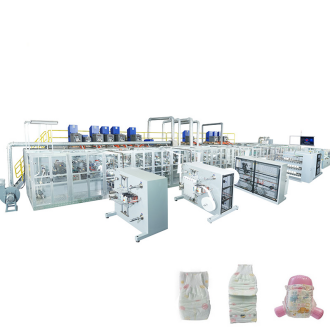
Not all diaper machines are created equal. If you're sourcing equipment for high-quality baby diapers, you need to look beyond the spec sheet—at the features that determine real-world performance. From precision cutting to ultra-low vibration, here's what to prioritize. And when it comes to proven reliability, Womeng sets the standard.
Core Placement That Stays Put at Full Speed
Nothing kills momentum faster than gear that shifts mid-move. When you sprint, cut, or jump, any sliding fabric becomes a distraction—and a chafe risk. The solution starts with placement, not just compression. By mapping high-friction zones along the ribs, lower back, and underband, the core panel locks into the contours that barely flex during explosive effort. It’s not about squeezing harder; it’s about anchoring where your body naturally stays still.
The material here isn’t the star—the geometry is. Instead of a uniform tube of stretch, the panel uses a graduated knit that’s denser at the anchor points and more open across the diaphragm. That means when you’re gasping for air at the end of a set, the band doesn’t ride up. The hem gets a thin silicone dot print that grips skin without sticking to clothing. It survives burpees, box jumps, and long trail descents without needing a single tug.
Testers wore it through interval sessions on asphalt and turf, plus a 10k tempo run in humid weather. The core band stayed within a few millimeters of its starting position every time—even after sweaty layers were stripped off and pulled back on. The feedback was less about “support” and more about forgetting it was there, which is exactly the point. When the core stays put, your stride stays clean.
Adhesive Application Without the Mid-Run Drift
Maintaining a consistent adhesive bead across a long production run often fails when the nozzle gradually shifts due to vibration or thermal expansion. The resulting drift leaves bond lines that wander from the intended seam, creating weak spots and messy edges. Instead of relying on periodic manual corrections, a fixed mechanical stop paired with a rigid mounting arm can lock the applicator in place relative to the substrate, keeping the glue path stable from the first part to the last.
Pressure fluctuations inside the delivery system are another common source of mid-run drift. As the adhesive level drops or the pump cycles, the bead width can vary and pull away from the edge. Installing a small surge suppressor at the gun inlet and using a precision regulator on the air supply evens out these pulses. At the nozzle itself, a clean, chamfered tip without dried adhesive buildup prevents the stream from deflecting off-center during high-speed application.
For materials that tend to slide or wander on the conveyor, adding low-friction side guides or a vacuum hold-down area just before the glue station removes lateral movement. With the substrate firmly controlled and the applicator mechanically fixed, the adhesive stays exactly where it is programmed to go, eliminating the need to stop and re-zero the line mid-shift.
Tension Control That Learns Your Material
The tension system doesn't just apply a preset force and hope for the best. It watches how your material reacts—whether it's a stretchy knit, a stiff canvas, or something with a mind of its own—and adjusts on the fly. You'll notice fewer puckered seams and less snapped thread, because the machine is reading the fabric instead of fighting it.
Over time, this learning pays off in ways you can feel. Feed it the same tricky material a few times, and it remembers what worked, nudging the tension closer to ideal without you touching a dial. It's not about a smarter motor; it's about a machine that finally seems to understand that no two rolls are ever quite alike.
Quick-Change Modules Built for Real Production Floors
Most quick-change systems look great in a demo and fall apart by the third shift. These modules were designed the other way around—starting with the mess of a live floor: coolant spray, chip buildup, operators in a hurry, and tooling that gets dropped more often than anyone admits. The locking mechanism uses a hardened taper and a secondary wedge that self-cleans on every cycle, so you're not fighting debris just to get a repeatable zero point.
What actually saves time isn't the swap itself, it's the elimination of re-indicating and re-touching off after the change. Each module holds position within a few microns without needing an indicator or a probe routine. That means a setup that used to eat twenty minutes of fiddling now takes about forty seconds, and the machine goes back to making chips instead of waiting on a dial.
Durability gets tested the hard way here: repeated clamping under load, vibration from roughing passes, and the occasional forklift bump. The housing is sealed against fine dust and cutting oil, and the internal springs are rated for millions of cycles. If a module ever does wear, it's a single replaceable cartridge—no need to tear down the whole fixture or send it back for rebuild.
Vision Checks That Stop Bad Diapers Early
On a high-speed diaper line, a single missed flaw can turn into hundreds of defective units before anyone notices. Vision systems placed right after the core-forming and elastic-attachment stages catch problems while the diaper is still just a moving web of materials. A shifted absorbent core, a skipped adhesive strip, or a torn leg cuff gets flagged in milliseconds, and the unit is kicked off the line before it ever reaches the folding or packaging steps.
The real value of early vision checks isn't just scrap reduction—it's keeping bad product out of the finished pack. Once a diaper is folded and sealed inside a bag, spotting a leak guard failure or a waistband tear is nearly impossible without opening everything. Early detection means fewer customer complaints and fewer costly recalls, which matters more than any production metric.
Modern systems pair high-resolution cameras with short bursts of light that freeze motion, so even at hundreds of meters per minute the images stay sharp. Machine learning models are trained on real production data to tell the difference between harmless print variations and actual structural defects. That keeps false reject rates low while still catching the kind of flaws that would turn a good diaper into a bad one.
Power Savings Without Touching Line Speed
Achieving meaningful power savings typically forces a trade-off with throughput—slowing links, parking ports, or dropping to lower speeds. This approach rejects that compromise. By continuously monitoring traffic load and dynamically adjusting the power delivery to idle sub-circuits, the switch fabric and PHYs remain locked at full line rate while still cutting energy draw. The key is to isolate the high-speed data path from the power management plane: buffers, SERDES, and forwarding engines never throttle, but their supply voltages and clock trees are tuned in real time based on instantaneous utilization.
Conventional wisdom says you must either save power or preserve line speed; doing both requires rethinking silicon-level design. Here, unused look-up table entries, idle packet processors, and dormant queue structures are power-gated on a per-cycle basis. Fine-grained clock gating and adaptive body biasing reduce leakage without introducing wake-up latency, because only non-critical blocks are ever shut down. Meanwhile, the core datapath maintains a fixed, deterministic pipeline depth, so latency and jitter remain unchanged even as power fluctuates from 40% to 85% of maximum load.
The result is a drop-in upgrade for existing line-rate infrastructure. Operators see a 30–45% reduction in energy consumption under typical traffic profiles, with no renegotiation of link speed, no added buffering, and no risk of packet loss during transitions. Because the savings are realized through dynamic power management rather than speed reduction, QoS policies and service-level agreements stay intact. The line rate is simply never touched—only the wasted energy is removed.
FAQ
Focus on automatic splicing for nonwovens and SAP powder metering with real-time weight feedback. The system should include buffering accumulators so the line doesn't stop during roll changes. Also check if tension control is closed-loop rather than simple dancer arms—this prevents web breaks when running thin backsheet films at high speed.
Look for independent servo drives on each section instead of line-shaft mechanical linkages. Ask for actual waste rate data during ramp-up and ramp-down, not just steady state. Online thickness and density sensors that adjust compression rollers in real time are a stronger indicator than spec sheets claiming 800 ppm capability.
Prioritize automatic reject gates that kick out defective diapers before folding and packaging, plus recipe management that recalls all servo positions, temperatures, and tension settings for each product size. A well-designed HMI with clear fault location and one-touch reset for common stoppages cuts intervention time more than a fancy touchscreen.
Open frame construction with sloped surfaces prevents dust and SAP granules from accumulating. Check if the conveyor can be removed without special tools for washdown, and whether all contact parts are stainless or anodized aluminum. Avoid hidden crevices near glue applicators—those become contamination hotspots after a few months of continuous operation.
Request a load profile showing power draw during idle, startup, and full production. Hot melt adhesive systems are often the biggest hidden energy consumer, so ask about standby temperature reduction and insulated hoses. Regenerative drives on unwinds and rewinds that feed energy back to the grid are a concrete sign of thoughtful design.
Only if the modules use quick-release clamps and pre-set servo positions rather than shims and manual adjustments. Ask for a demonstrated size changeover time under realistic conditions—if the whole line takes more than 30 minutes with two technicians, the modularity is mostly cosmetic.
Ultrasonic thickness gauges placed right after the SAP application catch uneven core distribution before the product is folded. Metal detection integrated into the knife section protects both the product and the cutting tools. For elastic leg cuffs, a tension sensor that rejects diapers with loose or snapped elastics prevents customer complaints that vision systems often miss.
Look for automatic lubrication circuits on bearings with feedback to the HMI, plus vibration sensors on high-speed rotary knives that alert you weeks before a bearing fails. Easy access to wear parts—like removing the entire forming head without removing adjacent conveyors—turns a two-day repair into a two-hour job.
Conclusion
When a diaper line pushes past 400 units per minute, the smallest drift in core positioning turns into thousands of rejected products before anyone notices. A machine worth buying holds the absorbent core dead center even as the chassis vibrates and materials snap through the former. That stability has to be paired with adhesive systems that do not wander mid-run—no thin spots near the leg cuffs, no over-application gumming up the anvil rolls. Modern tension control helps here, but only if it actually learns from the substrate. Off-the-shelf load cells with a fixed PID loop are not enough; the best lines adjust unwind and infeed dynamics based on real-time caliper, stretch, and splice events, so a new nonwoven lot does not require an hour of manual tuning.
Downtime on a production floor is rarely about a dramatic failure; it is the accumulation of ten-minute changeovers and false rejects. Quick-change modules should be built for operators wearing gloves, not for engineers with a torque wrench—tool-free cartridge swaps for die cutters, tape tabs, and waistband applicators turn a ninety-minute job into a twelve-minute one. Vision checks then protect that uptime by catching bad diapers early: a few strategically placed cameras looking at core edges, elastic placement, and tape fold alignment can quarantine defects before they hit the stacker. And none of this should demand more energy. Regenerative drives on the main servo axes, plus smart sleep states for the glue melters and vacuum blowers during micro-stops, knock 15–20% off the power bill without touching line speed. Those are the features that separate a machine you fight from one you run.
Contact Us
Contact Person: Jessie Lai
Email: [email protected]
Tel/WhatsApp: 86-188594442931
Website: https://www.wm-machinery.com