

Custom HVAC Duct Protection Film Manufacturer: High-Performance Solutions for Every Duct System
2026-05-17
When installing or renovating HVAC systems, protecting ductwork from dust, debris, and damage is critical—yet often overlooked. That’s where custom-fit protective films make all the difference. As a leading custom HVAC duct protection film manufacturer, Shire delivers high-performance solutions tailored to every duct system. In this post, we explore how Shire’s films ensure clean, efficient, and professional results from rough-in to final finish.
Tailored Film Solutions That Fit Your Ductwork Perfectly
Every ductwork system has its own quirks—odd angles, tight clearances, and awkward transitions that off-the-shelf films just can’t handle. That’s why we craft protective films specifically to your duct dimensions and geometry, ending the battle with bubbles, wrinkles, and peeling edges. From spiral round to rectangular risers, our film conforms precisely, staying put even around bends and seams.
We’ve moved beyond one-size-fits-all by engineering film solutions that accommodate the specific roughness, coatings, and thermal movement of your duct materials. Whether your system is galvanized steel, stainless, or fibrous glass, our adhesives are calibrated to bond securely yet remove cleanly without residue—no scraping, no ghosting, just a flawless finish that simplifies onsite handling.
Installation speed matters when you’re working against project timelines. Our pre-cut, labeled film kits drop right into your workflow, reducing waste and ladder time. With options for UV resistance, anti-static properties, or temporary marking surfaces, you get exactly what’s needed for the job—nothing generic, nothing wasted. It’s protection that fits like it was designed for your ductwork, because it was.
How We Engineer Durability into Every Protective Layer
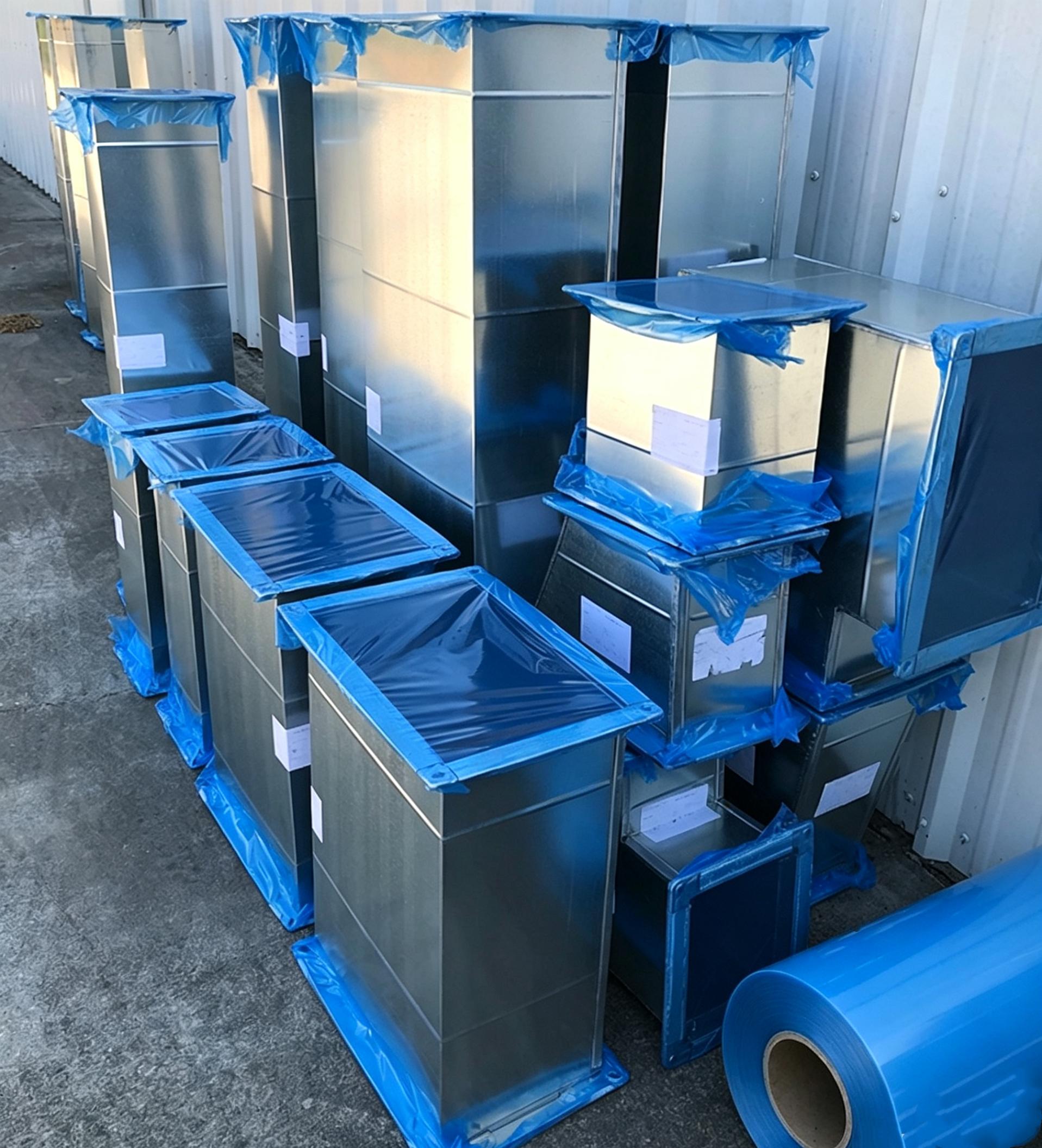
Durability isn’t a final coat we spray on at the end—it’s a thread that runs through every material choice and every bonding process. We begin by selecting substrates that resist micro-cracking under repeated stress, then pair them with adhesives that maintain their grip even when humidity and temperature swing wildly. This means the foundation of each layer is built to move and breathe with the product, rather than fight against it.
From there, we cycle the layers through a gauntlet of real-world abuse before they ever leave the lab. Abrasion from desert dust, flexing at sub-zero temperatures, and constant UV exposure aren’t simulated in isolation—they’re layered on top of each other, just as they would be in daily use. Only when a protective stack survives this deliberately messy testing do we trust it to keep the important things safe.
What gets us excited, though, is how the layers talk to one another. A scratch-resistant outer surface might shed impacts, but it’s the cushioning layer beneath that dissipates force before it reaches sensitive internals. And that middle layer is formulated to adhere precisely to both its neighbors, so gaps and weak spots never have a chance to form. The result is a system that doesn’t just protect once, but continues doing so long after the initial shine has dulled.
Beyond Standard Covers: Precision Protection for Unique Systems
Off-the-shelf covers rarely account for unconventional geometries, delicate sensors, or extreme operating parameters. When your equipment deviates from the norm—whether it's a custom optical assembly, a low-volume industrial machine, or a heritage restoration project—standard enclosures can leave vulnerable points exposed. Precision protection means analyzing every contour, material interaction, and environmental stressor, then engineering a barrier that integrates seamlessly without compromising accessibility or performance.
This approach goes beyond simple dust and moisture ingress prevention. It considers thermal expansion mismatches, chemical resistances, electromagnetic interference, and even aesthetic continuity. By employing advanced metrology and rapid fabrication techniques, each protective element is shaped to the exact profile of the underlying system, often with tolerances measured in microns. The result isn’t a generic shell but a second skin that actively prolongs service life and sustains operational accuracy.
Investing in tailored protective solutions eliminates the costly trade-offs of make-do covers—gaskets that don’t seat properly, ports that require field modifications, or materials that degrade prematurely. Instead, you gain a component that was purpose-built for its role, reflecting the same care and specificity that went into the device it shields.
The Material Science Behind Our High-Performance Films
At the heart of our films lies a carefully calibrated polymer blend that balances flexibility with exceptional tensile strength. By manipulating molecular weight distribution and crosslinking density during extrusion, we control how the film behaves under stress—stretching just enough to conform to irregular surfaces without tearing or losing dimensional stability. This isn't a one-size-fits-all formula; we fine-tune the viscoelastic properties for each application, ensuring the material absorbs shock and resists puncture in ways that off-the-shelf plastics simply can’t match.
Surface functionality is engineered directly into the film rather than applied as an afterthought. Through plasma treatment and chemical vapor deposition, we introduce polar groups that lock onto inks, adhesives, or barrier coatings with covalent-level adhesion. Meanwhile, embedded nanoparticle layers scatter UV light without compromising optical clarity—a trick borrowed from composite optics that keeps the film transparent while blocking harmful radiation. The result is a material that repels moisture, resists yellowing, and holds a print for years with zero delamination.
Thermal behavior is another axis we design for, not around. By incorporating liquid crystal polymer segments that undergo reversible phase transitions at precise temperatures, the film can shift from rigid to pliable within a narrow window—ideal for heat-seal packaging or shape-memory overlays. We also leverage controlled crystallization kinetics to prevent brittleness in cold environments, so the film remains tough whether it’s in a freezer or under desert sun. Every layer is co-extruded in a single pass, merging these functions without adhesives, which keeps the profile razor-thin and the scrap rate near zero.
Step-by-Step: Protecting Ducts During Transport and Installation
Before ducts even leave the fabrication shop, a solid protection plan starts with how they're stacked and wrapped. Use non-abrasive spacers between each piece to prevent scratches and dents, and opt for breathable, heavy-duty plastic sheeting rather than fully sealing them in non-ventilated wraps that can trap moisture and lead to corrosion. Make sure the ends are capped with rigid, well-fitted covers—not just tape—to keep out debris and critters during transit.
Loading and unloading is where the real damage often happens. Always lift ducts with wide fabric slings or purpose-built spreader bars, never with chains or thin cables that can crush corners. Inside the truck, secure them firmly with padded straps and dunnage that distributes pressure evenly, and avoid stacking anything on top of lighter-gauge ducts. If you're hauling multiple sizes, place the heavier, larger ducts at the bottom and use custom-cut foam blocks to fill gaps and stop shifting.
Once on site, treat the staging area as an extension of the transport protection. Lay ducts on level ground covered with plywood or protective mats—never directly on dirt, gravel, or concrete. Keep end caps on until just before connection, and store lengths so they don't become tripping hazards or get hit by moving equipment. For vertical risers or sections that will sit exposed for a while, a simple wrap of protective film can guard against dust, paint overspray, and incidental contact from other trades.
Real-World Applications: From Residential to Heavy Industrial
In everyday life, the technology quietly powers the conveniences we often take for granted. In residential settings, it ensures stable energy flow for smart homes, quietly managing rooftop solar inputs and battery storage while homeowners go about their routines. From keeping the lights on during a grid outage to optimizing electric vehicle charging when rates are lowest, these systems blend seamlessly into the background, adapting without needing constant attention.
Step onto a commercial site and the demands shift dramatically. Office parks and retail centers rely on the same core principles but scaled to handle unpredictable peaks — think of a midday rush at a shopping mall or a sudden heatwave forcing every HVAC unit to full blast. Here, the equipment must not only be robust but also intelligent enough to coordinate with backup generators and local utility signals, shaving off costly demand charges while maintaining comfort and safety for hundreds of occupants.
At the extreme end, heavy industrial facilities operate in a world of relentless stress. Steel mills, chemical plants, and remote mining operations push every component to its limits, where voltage sags lasting milliseconds can ruin entire batches or halt production for days. In these harsh environments, the gear is engineered for survival — coated against corrosive fumes, braced against vibration, and often housed in blast-proof enclosures. It’s here that the true grit of the design shines, enabling processes that consume megawatts yet remain stable even when massive motors start under load or a fault ripples through the network.
FAQ
Every film we produce is tailored to the exact dimensions and performance needs of the duct system. Instead of forcing a generic product to fit, we engineer the film’s adhesion, thickness, and durability based on where and how it will be used, which means fewer callbacks and less material waste on site.
Our high-performance films are formulated with advanced polymer blends that resist peeling and bubbling even when ducts carry heated air or are exposed to condensation. We test adhesion under thermal cycling and high humidity, so the film stays put and continues protecting the duct surface long after installation.
Absolutely. We customize the adhesive system for each substrate—whether it’s galvanized steel, aluminum, or flexible insulated duct. The film conforms to curves and seams without lifting, and we can adjust the tack level so it removes cleanly without leaving residue, even on sensitive surfaces.
You can choose from different colors for job-site identification, add perforations for easy tearing, incorporate anti-static properties for cleaner handling, or print your company logo and handling instructions directly on the film. We also tailor the roll length and core diameter to fit your production line or field workflow.
We base our adhesive selection on the duct material and the expected protection period. For long-term applications, we use UV-stable, low-residue adhesives that release smoothly. We also run peel-adhesion tests on actual duct samples you provide, so you know exactly what to expect before we ship.
As a manufacturer, we keep raw materials in stock and can adjust production schedules quickly. Our dedicated project specialists will work with you to meet tight construction timelines, and we offer just-in-time delivery to your facility or job site to keep your project moving.
Conclusion
Every HVAC system comes with its own set of dimensions, routing complexities, and environmental challenges, which is why off-the-shelf films rarely provide the snug, reliable fit installers need. We design tailored film solutions that conform seamlessly to rectangular, spiral, or oval ductwork, eliminating gaps that let moisture and debris sneak in. Our process begins by analyzing the exact duct profile and operational context—whether it's a tight residential crawlspace or a sprawling industrial facility—so each protective layer is engineered for that specific application. By combining multi-layer co-extrusion with reinforcing scrim, we build in puncture resistance, tensile strength, and temperature tolerance without adding bulk. That focus on material science means our films withstand rough handling during transit, shield against UV exposure on outdoor staging, and peel away cleanly after installation, leaving no adhesive residue that could compromise indoor air quality.
Precision protection goes beyond standard covers: we offer custom die-cut slits, easy-release liners, and color coding for quick size identification, speeding up on-site workflow while reducing waste. Our step-by-step guidance for protecting ducts during transport and installation is baked into every roll—from how to wrap elbows and joint flanges to the ideal tension for securing film without crushing insulation. We’ve seen our solutions safeguard ductwork in everything from high-rise residential towers to heavy industrial plants where chemical exposure and abrasive grit are daily threats. The result is a cost-effective system that cuts callbacks, maintains system integrity, and lets contractors focus on what they do best, knowing each duct arrives on site in showroom condition.
Contact Us
Contact Person: Jack Xu
Email: [email protected]
Tel/WhatsApp: 8615257328825
Website: https://www.temporaryprotectivefilm.com/